




Fruit Growing Bags: What They Are, How They Work, and How to Choose the Right Type
What Are Fruit Growing Bags?
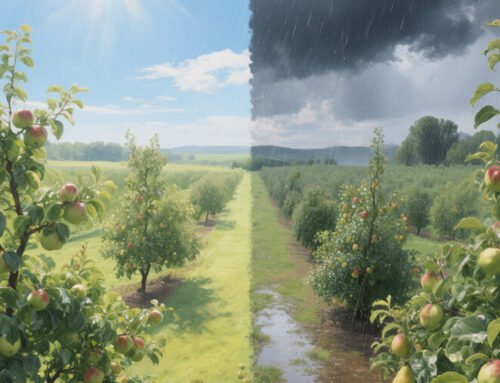
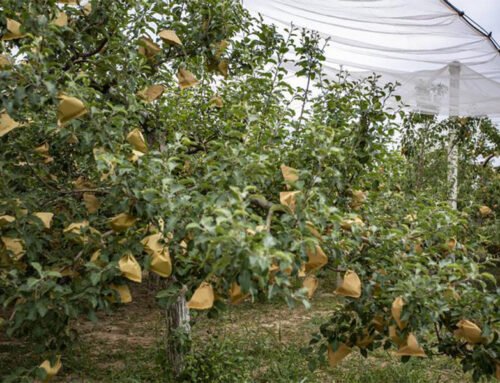
A fruit growing bag is a single-use or reusable cover that encloses developing fruit on the tree. Instead of treating the whole orchard against a pest or disease, you physically isolate the fruit. Because the barrier stays in place, protection lasts the whole bagging window, typically 8 to 20 weeks, rather than the 7 to 14 days a spray residue remains effective.
Research funded by USDA’s Southern Sustainable Agriculture Research & Education (SARE) program at Clemson University’s Musser Fruit Research Farm found that bags protected peaches from brown rot, plum curculio, and birds while maintaining the sugar-to-acid ratio and fruit size of sprayed peaches (SARE Southern, Grant OS16-094). A West Virginia study found bagged apples suffered significantly less pest damage than unbagged fruit and generally matched a full conventional spray program (Frank, 2018, Insects 9(4): 178).
Important distinction: two products share this name. “Fruit growing bags” is sometimes used loosely for fabric grow bags: porous non-woven containers you fill with potting mix to grow a blueberry bush or dwarf fruit tree in. Those are containers, not covers. This article is about bagging bags, the protective sleeves applied to fruit on the tree. If your crop is in the ground and your concern is insects, birds, sunburn, or residue, you want the product described here.
What Fruit Growing Bags Do: Six Field Benefits
1. Physical pest exclusion
Exclusion is continuous rather than dependent on spray timing. A 2019 Ohio trial recorded codling moth damage in 41% of unbagged, untreated apples versus 19% of bagged fruit, and a Montana State University study on ‘Cortland’ apples cut strike from 34–35% to 10–12% (Montana State University WARC).
2. Disease reduction
Bags block the rain splash and spore deposition that drive surface diseases. In the West Virginia trial, two-layer commercial bags gave the best disease control of the materials tested, including sooty blotch and flyspeck (Frank, 2018). Ohio State’s home-orchard bulletin lists flyspeck and apple maggot among the problems bagging addresses (OSU Extension, Bulletin 780).
3. Sunburn, rain, and mechanical buffering
Bags moderate the fruit’s microclimate: heavier layers cut direct radiation and sunscald, and the covering limits wind rub, hail marks, and branch chafing. Clemson researchers noted that bagging may limit skin disorders caused by pesticide residue, acid rain, and heat stress, reducing post-harvest culling (Farm Progress / Clemson).
4. Lower residue and fewer spray passes
Because the barrier does the work, spray frequency can come down. Published orchard work associates bagging with reductions of roughly 40% in pesticide application frequency, and public research frames the technique as a route to low-residue and organic production, particularly where fungicide resistance has made chemical control unreliable (Farm Progress / Clemson).
5. Higher marketable yield and premium pricing
The economics are concrete. In the Clemson/SARE organic peach trial, unbagged fruit yielded at a 20% baseline; bags raised yields 10–15%, and spraying before bagging added a further 35%. Consumer surveys run alongside the trial found shoppers would pay an average of $0.38 more per pound for bagged peaches, up to $1 more per pound once told the fruit was chemical-free (SARE Southern).
6. Better color control and a more uniform pack-out
Inner-layer color is the mechanism: red supports anthocyanin development in red cultivars such as Fuji, while black suppresses chlorophyll and suits yellow or green cultivars. The trade-off is less blush. Clemson found bagged peaches paler than unbagged, though sugar content, acidity, size, and weight were unchanged.
Types of Fruit Growing Bags
Four material families cover almost all commercial bagging, plus a fast-growing biodegradable segment.
| Type | Structure / typical spec | Light | Strengths | Limitations | Best for |
|---|---|---|---|---|---|
| Double-layer paper | Outer 40–60 g/m² + inner 25–35 g/m², wax or film coated, V-cut bottom | Shaded, tunable by inner color | Best all-round protection; strong color control; biodegradable | Absorbs water in heavy rain; needs dry storage | Apples, pears, mid/late peaches |
| Single-layer paper | 30–80 g/m² kraft | Moderate | Cheapest paper option; breathable | Lower wet strength; less disease control | Early peaches, apricots, plums, grapes |
| Non-woven (spunbond PP) | 30–50 g/m², 60–80% shading | Medium (20–30% transmission on grape grades) | High tear strength; reusable 1–2 seasons; good airflow | Higher unit cost; must be disinfected before reuse | Grapes, kiwifruit, early peaches |
| Mesh / organza (nylon or PE) | ~1 mm aperture for moth exclusion; 15 mm netting for birds only | High (>85% transmission) | Maximum airflow; visible fruit; reusable for seasons | No control of thrips or aphids; limited hail and frost protection | Berries, cherries, guava, bird-only pressure |
| Film (PE), plain or UV-stabilized | 0.01–0.03 mm, often perforated | Variable, can be tinted | Lowest cost; waterproof; strong insect barrier | Poor breathability traps heat and causes rot or sunscald; not for long-hanging cultivars | High-volume orchards, short-season and tropical fruit |
| Bio-based / compostable | PLA, PBAT, starch blends, or uncoated paper | Varies | Compostable; supports organic certification and EU/North American packaging rules | Higher cost; performance varies widely by supplier | Organic orchards, export programs requiring compostability |
Two cautions from the research. First, grammage is not “heavier is better.” Bags below roughly 30 g/m² embrittle quickly under strong sun, but outer layers above about 70 g/m² cut internal ventilation and, in humid regions, increase surface russeting. Second, plastic zip-top bags solve one problem and create another: in the Montana trial they left fruit shrivelled in trapped heat and attracted earwigs whose frass spoiled the pack-out, and the UC trials explicitly advised against them (UC IPM).
Bag Sizes by Crop
Sizes below are the ranges most commonly quoted across commercial bag catalogs. Always size for the mature fruit diameter, not the size at bagging time — a bag that fits a golf-ball peach will split or chafe as the fruit doubles in volume. For custom sizing, leave at least 30–50 mm clearance.
| Crop | Typical bag size (mm) | Layers | Notes |
|---|---|---|---|
| Apple | 150 × 180 to 180 × 200 | Double | Red inner layer for red cultivars; V-cut bottom drains better in wet regions |
| Pear | 160 × 198 to 200 × 240 | Double | Black inner layer suits yellow/green cultivars |
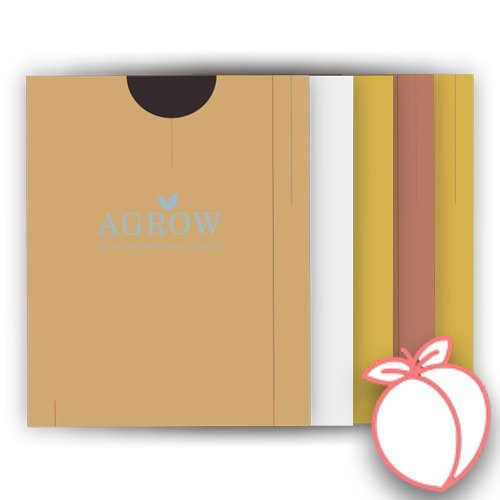
| Peach / nectarine | 150 × 180 to 170 × 230 | Double (single for early cultivars) | Bottom drainage holes, 5–8 mm, at least four |
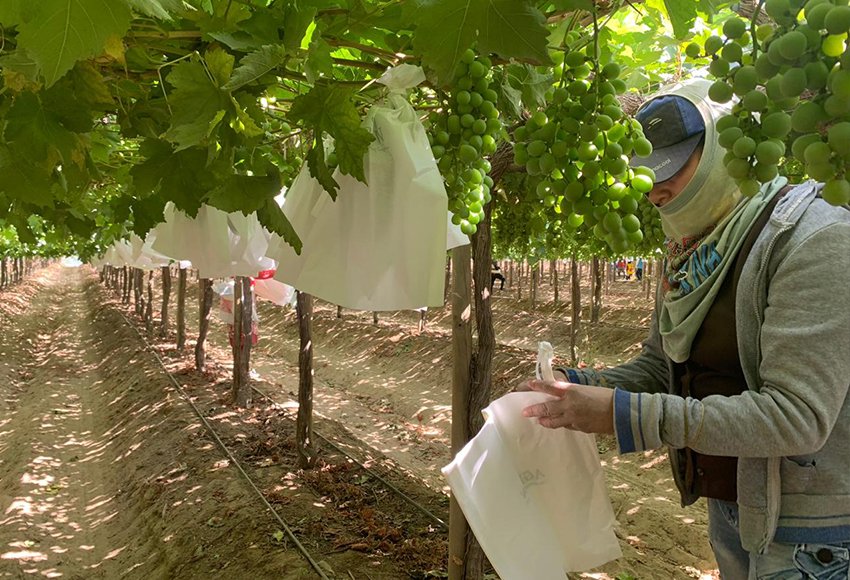
| Grape (per bunch) | 215–290 × 330–360; up to 330 × 430 for large-cluster types | Single | Non-woven preferred over paper; paper splits under bunch weight |
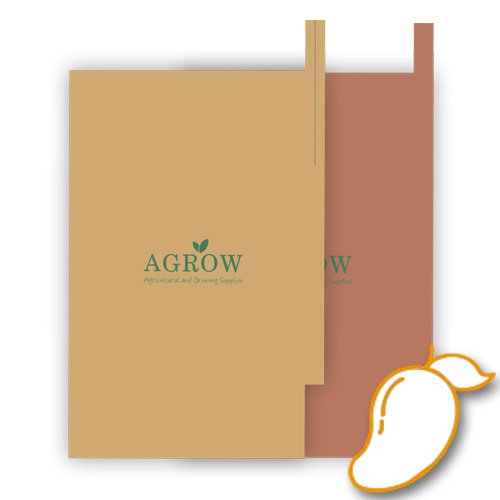
| Mango | 200 × 300 to 220 × 320 | Single or double | |
| Guava | 200 × 220 to 220 × 280 | Single | |
| Kiwifruit | 160 × 280 to 180 × 250 | Single | Requires smooth inner surface; rough linings scar the skin |
| Banana (per bunch) | 770–1400 × 1300–1500 | Single or double | |
| Citrus / pomelo | 200 × 300 and upward | Single or double |
When to Apply and Remove Bags
Timing is the single biggest determinant of bagging success, and the window is narrow.
| Crop | Bagging window | Source |
|---|---|---|
| Apple | 30–35 days after petal fall, fruit 12–25 mm, clusters thinned to one fruit | WSU; OSU Bul. 780 |
| Pear | After fruit set, fruit roughly 25 mm | OSU Bul. 780 |
| Peach | About 3 weeks after petal fall, golf-ball size; finish before mid-June in most regions | Clemson / SARE |
| Grape | When berries reach pea/soybean size | Grower protocol |
Bagging too early knocks off fruitlets that would have dropped naturally, wasting bags and labour, and Clemson’s team puts the correct moment at roughly golf-ball size. Bagging too late means eggs are already on the fruit; UC notes that later apple cultivars tend to show infestation inside the bag when bagging starts after the first egg-lay. Two operational details matter for cost planning: apply bags in dry morning or late-afternoon hours rather than midday heat, and allow 2–3 days after any pre-bagging spray.
Removal practice differs by market. WSU recommends taking bags off about two weeks before harvest for color development; OSU suggests 2–3 weeks. The Clemson peach work left bags on until harvest, accepting paler fruit for full-season protection. Decide which variable you are optimizing, color or protection, before you commit.
8 Criteria for Choosing Fruit Growing Bags
1. Match the material to the pest you actually have
Mesh aperture, not bag “type,” determines insect exclusion. Field guidance converges on ≤0.8 mm for codling moth, plum curculio, and oriental fruit moth, and notes that bags labelled “1 mm” often measure 1.1–1.3 mm under tension, enough to let first-instar larvae through. If birds are your only pressure, 15 mm hexagonal netting plus a visual deterrent usually suffices. Against thrips or aphids no practical bag works; those need biocontrol or targeted spray.
2. Size to mature fruit, with 30–50 mm clearance
Undersized bags chafe and deform fruit; oversized bags are heavier, catch wind, and fall off. Buy for the finished fruit.
3. Set light transmission to hit your grade target
If your buyer pays for blush or uniform skin finish, light transmission and inner-layer color are commercial variables, not details: black inner layers for yellow/green cultivars, red for red cultivars, and higher-transmission non-woven for grapes, where 20–30% is the practical band.
4. Check ventilation and drainage design
This is where cheap bags fail. Ask for side ventilation holes of 3–5 mm at 10–15 cm spacing, not bottom-only vents, which the fruit itself blocks. For peaches and other rot-prone crops, require at least four 5–8 mm drainage holes and a V-shaped bottom, which drains more reliably than a straight cut.
5. Buy wet strength and UV stabilization, not thickness alone
Paper that turns to pulp in the first rainstorm destroys the season’s investment. Look for stated wet tensile strength and UV stability evidence; for non-woven, ask for UV stabilizer concentration. Then test the aperture on a sample: hold the bag to the sun; if you can read your fingerprint through the weave, it is too open for moth exclusion.
6. Test the fastener against your orchard’s wind
Closure is the most under-specified component in the category. In the West Virginia trial, the share of bags still attached at harvest ranged from 0.54–0.71 for commercial two-layer bags, 0.64–0.82 for plastic bags, and 0.32–0.60 for paper bags. With a weak tie, a third to half of paper bags may not survive to harvest. Braided drawstrings with reinforced toggles outperform elastic closures, which stretch out after two seasons, and paper bags generally take longer to secure than plastic or two-layer commercial bags.
7. Verify food-contact compliance and traceability
For export programs, documentation matters as much as product. Ask for ISO 9001, ISO 22000 or equivalent food-contact certification, FDA or EU food-contact compliance for coatings and inks, and third-party test reports. If the bag is sold as biodegradable or compostable, request the degradation test evidence rather than a marketing claim.
8. Calculate cost per marketable fruit, not cost per bag
The Clemson/SARE figures make the arithmetic concrete: bagging a mature tree carrying about 400 fruit cost $14–17, split between $10–12 in labor and $4–5 in bags. At a $0.38/lb premium and roughly 250 lb of fruit per tree, that returned about $95 per tree in extra revenue for direct-to-consumer sales. A bag that costs 40% less but loses half its stock before harvest is not cheaper.
Run a trial before a container load
Before a bulk order, buy a specimen range and run one season on 20–30 trees. Measure four things: bag retention at harvest, damage incidence versus unbagged fruit, color grade achieved, and handling time per tree. Those numbers tell you more than any spec sheet, and they give your supplier a clear target to engineer against.
Frequently Asked Questions
What are fruit growing bags used for?
To protect fruit on the tree from insects, birds, fungal spores, rain, hail, and sunburn, and to reduce pesticide residue on the fruit surface. Commercial growers also use them to steer skin color and raise first-grade pack-out.
Are fruit growing bags the same as grow bags?
No. Grow bags are porous fabric containers you fill with potting mix to grow plants in. Fruit growing bags are protective covers tied around fruit still attached to the tree.
What size bag do I need for my crop?
Size against the mature fruit diameter plus 30–50 mm clearance. Apples typically take 150 × 180 to 180 × 200 mm double-layer bags, pears 160 × 198 to 200 × 240 mm, grape bunches 215–290 × 330–360 mm, mangoes 200 × 300 to 220 × 320 mm.
Paper, non-woven, or mesh: which is best?
Double-layer paper gives the best all-round protection and color control but the lowest wet strength. Non-woven is stronger, reusable, and better for grapes and kiwifruit. Mesh offers maximum airflow and suits bird pressure, but cannot exclude very small insects. Match the material to your dominant risk, not to price.
When should I bag fruit?
When fruit is large enough to survive handling but before egg-laying peaks: apples at 30–35 days after petal fall (12–25 mm), peaches at golf-ball size roughly three weeks after petal fall, grapes at pea size. Bagging earlier wastes bags on fruit that will drop naturally.
Do bags reduce sugar or flavor?
Evidence is mixed. The Clemson peach trials found sugar and acid content, and their ratio, unchanged between bagged and sprayed fruit. The West Virginia apple study found Brix higher in unbagged fruit than in any bagged treatment, with fruit diameter not significantly different. Expect a color shift and, on some apple cultivars, a small Brix effect. Test on your own crop before scaling up.
Can bags be reused?
Non-woven and mesh bags can generally be reused for one to two seasons if cleaned and dried properly. Reusing without disinfection can turn the bag into a disease vector, so build a cleaning step into the cost model. Paper and film bags are single-use.
What certifications should I ask a supplier for?
At minimum ISO 9001, food-contact compliance for coatings and printing inks, and third-party reports for aperture, wet tensile strength, and UV stability. For compostable or biodegradable claims, request the degradation test report itself.
What order quantity and lead time should I expect?
MOQs commonly start around 10,000 pieces per size and design. Custom sizes, printed branding, and inner-layer colors extend lead time, so plan backwards from your bagging window rather than forwards from your purchase order.
Choosing a Fruit Growing Bag Supplier
Specification alone rarely decides a purchase — consistency does. Over a 20-week season, a batch with variable aperture or uneven coating fails in the field, where it is most expensive to fix. Ask for batch-level test data rather than a one-off certificate, confirm custom capability in size, layer count, inner color, vent pattern, and printing, and insist on a sample program that lets you run a side-by-side trial on a real block before the season starts.
We manufacture paper, non-woven, mesh, and compostable fruit growing bags to custom specifications, and we supply trial quantities so you can validate retention, damage rates, and color grade on your own trees before placing a production order.
Request a sample pack and specification sheet →
Sources
- Southern SARE / Clemson University, Paper or Pesticides? Bagging Peaches Protects from Insects and Diseases, On-Farm Grant OS16-094
- Frank, D.L. (2018), Insects 9(4): 178, apple bagging trial
- Farm Progress / Clemson University, Clemson has organic peach growing ‘in the bag’ (Melgar & Schnabel)
- University of California IPM, Codling Moth Quick Tips
- Washington State University Extension, Home Orchards, PNW Gardeners Handbook, Ch. 8
- Ohio State University Extension, Controlling Diseases and Insects in Home Fruit Plantings, Bulletin 780
- Montana State University WARC, Bagging apple fruit for codling moth control
- Supplier specification data from public commercial bag catalogs, accessed October 2026; figures are indicative and should be confirmed by sample test.
Compiled October 2026. Cited figures reflect the individual studies and trial conditions referenced above; results vary by cultivar, climate, and pest pressure.